- April 20, 2026
- Kalmsu Team

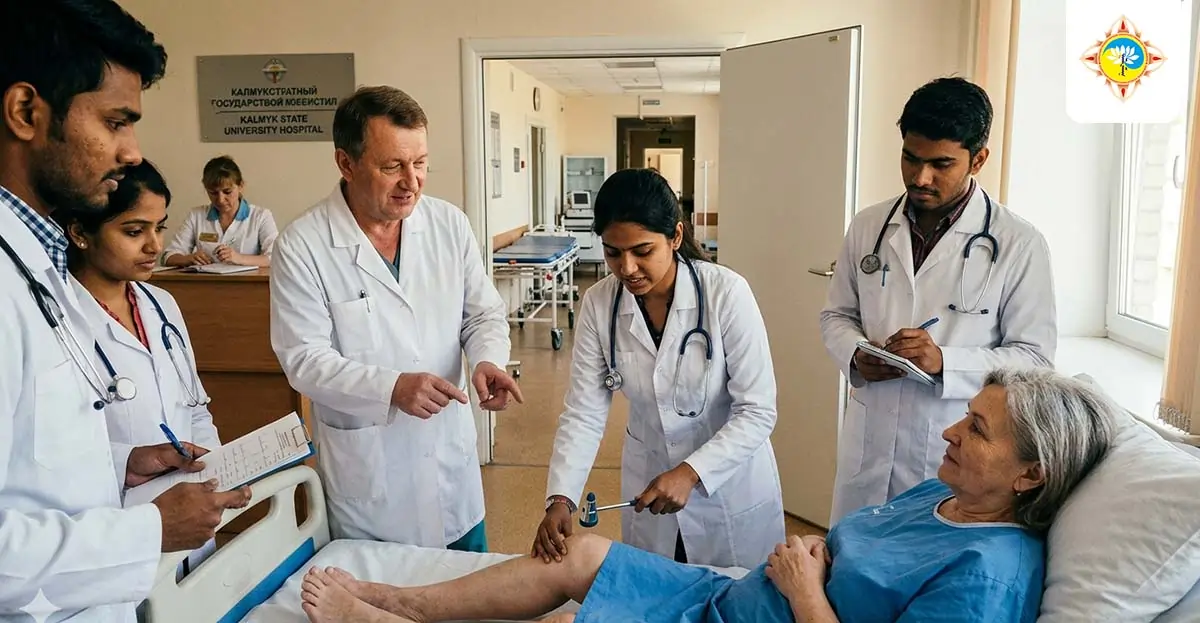
One of the biggest concerns for a medical aspirant planning to pursue an MBBS in Russia is whether they will receive real clinical exposure. At Kalmyk State University, the answer is clear and reassuring. The university combines strong theoretical teaching with hands-on clinical training that prepares Indian students for real-world medical practice.
Let’s explore what clinical exposure in Russia truly looks like at Kalmyk State University and how it shapes your journey from a student to a confident doctor.
Clinical exposure is where medicine becomes real. It is the phase where students stop memorising and start understanding patients, diseases, and treatments.
In MBBS clinical training, students learn:
Without this, even the best theoretical knowledge remains incomplete. This is why hands-on experience in MBBS Russia universities plays a crucial role in shaping future doctors.
➨ Also Read: How Kalmyk State University MBBS Opens Doors for Indian Students?
Here's what the clinical training looks like at Kalmyk State University:
From the third year onwards, students begin their clinical practice in Russia through:
This step-by-step exposure ensures that students are not overwhelmed and develop confidence gradually.
Kalmyk State University provides modern laboratories and simulation-based training facilities that support early clinical skill development. Students benefit from:
This integrated approach strengthens practical medical training.
At Kalmyk State University, the MBBS program spans 6 years:
Clinical learning at Kalmyk State University takes place in affiliated hospitals, which act as real training grounds.
Here, students:
These hospitals are an integral part of clinical practice in Russia, allowing students to bridge the gap between classroom and real-world medicine
One of the most unique aspects of studying at Kalmyk State University is its focus on Indian students.
The university offers:
This is extremely valuable because:
This dual exposure enhances the overall clinical exposure in Russia and makes graduates more adaptable.
A common concern among Indian students is language.
At Kalmyk State University:
This helps students:
Language training ensures that students do not miss out on real clinical practice in Russia due to communication barriers.
The sixth year of MBBS is entirely focused on clinical immersion.
During this phase:
This internship is the most critical part of the MBBS clinical training. This is where students transition from learners to practitioners.
It prepares them for:
The structured clinical training at Kalmyk State University ensures that students are ready not just for India, but for global opportunities.
Graduates are eligible for licensing exams such as:
This is possible because:
This makes MBBS in Russia a strong pathway for a global medical career.
Choosing the right university is not just about fees or rankings. It is about how well you are trained to treat real patients.
At Kalmyk State University, clinical training is:
From simulation labs to hospital rotations and internships, students receive complete hands-on experience in MBBS Russia universities.
Feel free to contact us if you want to kickstart your bright medical future here.
Q.1 Can Indian doctors practice in Russia?
Answer: Yes, Indian doctors can practice in Russia after fulfilling licensing requirements. They must get their degree recognised (nostrification), clear the Russian medical accreditation exam, demonstrate Russian language proficiency (B2 level), and register with authorities. Without this license, they cannot legally practice medicine in Russia.
Q.2 Is NEET accepted in Russia?
Answer: Russian medical universities require Indian students to qualify for NEET for admission into MBBS programs. A valid NEET score is essential, as it ensures that the degree is compliant with the National Medical Commission (NMC), allowing graduates to practice medicine in India in the future.
Q.3 Why is MBBS so cheap in Russia?
Answer: MBBS in Russia is affordable mainly due to strong government subsidies at public medical universities. This often covers up to 50% of the actual education cost. Moreover, the absence of private, profit-driven medical colleges eliminates high donation fees, and relatively low living expenses further make it a budget-friendly option for international students.
Q.4 How to get MBBS seat in Russia for Indian students?
Answer: Indian students seeking an MBBS seat in Russia must qualify for NEET, be at least 17 years old, and secure a minimum of 50% in PCB in Class 12. The process includes applying to NMC-compliant universities, receiving an invitation letter, and then applying for a student visa, usually beginning around May-June.
Q.5 What is the age limit for MBBS in Russia?
Answer: The minimum age required for MBBS admission in Russia is 17 years as of December 31 of the admission year. Most Russian medical universities do not set an upper age limit for international students.
October 21, 2026

© Copyright Kalmyk State University 2026. All Right Reserved. Designed and Developed by Kalmyk State University
.webp)