- October 27, 2026
- Kalmsu Team

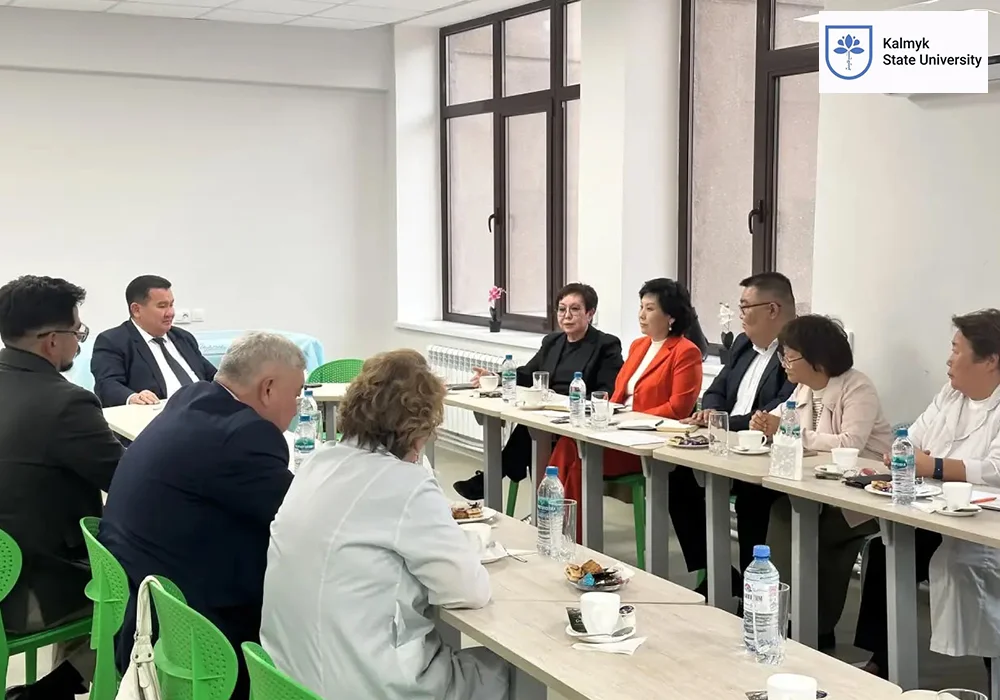
Kalmyk State University held public hearings to discuss the development programme of its Faculty of Medicine for 2027–2030 in Elista, Republic of Kalmykia, Russia. The discussion focused on integrating the Faculty of Medicine into the university’s broader development programme, with particular attention to improving education, strengthening research, supporting students, and increasing the faculty’s contribution to the region.
The development programme is structured around four core areas: education, research, student development, and the university’s role in the region. For each area, the faculty is examining three key questions: what activities are being carried out, what projects are being implemented, and how progress and results will be measured.
The Faculty of Medicine’s development programme outlines a transition from its initial launch stage towards long-term and sustainable quality development.
One of the priorities is establishing a stable and permanent faculty and staff base. The programme also includes plans to create clinical training sites directly within medical institutions, allowing practical medical education to be supported through clinical facilities.
The faculty also plans to expand facilities associated with the Department of Fundamental Disciplines. Another proposed development is a faculty-affiliated clinic, with outpatient and primary care services planned as the initial focus.
As the number of academic staff and the clinical workload increase, the programme also envisages the eventual division of the clinical department into separate tracks for General Medicine and Pediatrics.
Another important component is the completion of the educational pathway through preparation for accreditation. This includes plans for a collaborative “network” model with Astrakhan State Medical University, supporting the further development of the Faculty of Medicine’s educational structure.
The development programme reflects an approach that goes beyond increasing student enrollment. Its stated priorities include strengthening academic staffing, clinical training infrastructure, research capacity, student development, and connections with regional healthcare needs.
Through these measures, Kalmyk State University aims to integrate the Faculty of Medicine more closely with the university’s overall development programme through 2030. The public hearings provided a platform to discuss the faculty’s planned direction and the measures intended to support its long-term development.
Kalmyk State University’s Faculty of Medicine development programme for 2027–2030 focuses on building a stronger and more sustainable academic and clinical foundation. With priorities covering education, research, student development, and regional engagement, the programme outlines a broader approach to developing medical education at the university.
The planned expansion of clinical facilities, academic staffing, research activity, and regional partnerships will form key elements of the faculty’s development through 2030.

© Copyright Kalmyk State University 2026. All Right Reserved. Designed and Developed by Kalmyk State University